

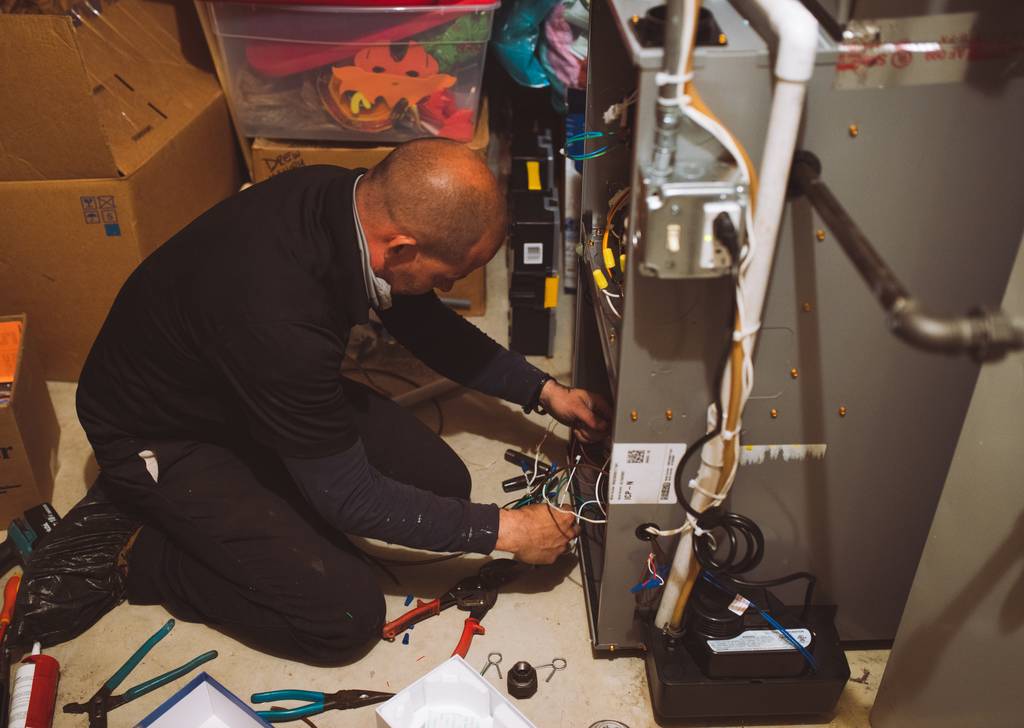
Often, yes. Repair is usually the right call when the furnace is under about 12 years old, one common wear part has failed, and it is the system first real failure. Replacement usually wins once the unit is past 15 and the repair runs into four figures, when the same furnace has failed twice in one heating season, when parts are no longer available, or when a technician confirms a cracked heat exchanger. That last one is not a cost decision. That furnace stops running.
Most people asking this are not planning ahead. The heat came on for the first time this fall, something went wrong, and now there is a decision to make in a cold house with a technician standing in the basement.
At Topline, the assessment starts with your specific house. If replacement is not the right next step, we will tell you.
This guide is about gas furnaces. Electric furnaces, oil systems, boilers and heat pumps have different components and different answers.
Start with safety
If a carbon monoxide alarm sounds, get everyone outside immediately, then call 911 from outside. If you smell gas, leave without touching light switches or anything electrical, and call your gas utility emergency line or 911 from a safe location. Do not stay inside to troubleshoot, and do not go looking for the leak yourself.
Separately from any furnace decision, keep working CO alarms on every level of the home and outside sleeping areas. CPSC recommends interconnected alarms, so that when one sounds they all do. Alarms are not a substitute for a professional inspection.
For a furnace that has simply stopped working with no emergency warning, get a diagnosis before deciding anything. A failed thermostat and a cracked heat exchanger both leave you cold, and they lead to opposite decisions.
| What the diagnosis finds | What to do |
|---|---|
| One failed wear part, system otherwise sound, no safety defect | Repair it. Get the quote, but this is a repair. |
| A four-figure repair on a furnace past 15, with other components worn | Get both numbers, the full repair and a replacement estimate, and compare them directly. |
| Second failure in the same heating season | Replace. The system is telling you what comes next. |
| Confirmed heat-exchanger defect | Shut it down. Do not run it again until it is resolved. |
| Furnace and air conditioner both near end of life | Ask for a furnace-only and a combined estimate before choosing. |
Fifteen years is a reason to evaluate, not an expiration date
ENERGY STAR advises considering replacement once a furnace is more than 15 years old. Considering is the operative word. Plenty of furnaces in Lancaster County basements are past 15 and have years left, and plenty of twelve-year-olds in poorly ducted houses are finished.
Installation quality and maintenance history matter more than the number on the label. A furnace that was correctly sized, properly vented and serviced most years will outlive one that was oversized on install day and never touched again.
The useful question is not how old it is. It is what condition it is in, and what you would be paying to keep it running.
When repairing is the right call
Repair when the furnace is under roughly 12 years old, the failed part is a common wear item, it is the first real failure, and parts are available. Common wear items include the igniter, flame sensor, capacitor, pressure switch and thermostat.
A ten-year-old furnace with its first igniter failure is a repair. A fifteen-year-old unit with a modest repair, available parts and no other symptoms is usually a repair too. A furnace that will not start does not automatically need replacing, and anyone who says otherwise before diagnosing it is guessing.
Ask for the full repair price, the warranty on the work, and anything else the technician found while they were in there. Check whether a manufacturer warranty still covers the failed part. Labor and related work will usually still be yours.
One exception: a tripped safety control or pressure-switch fault needs its cause found. Swapping the switch or resetting the furnace repeatedly without knowing why it tripped is not a repair.
When replacement is the right call
Replacement earns serious consideration when several of these overlap: a major component has failed, other components are visibly deteriorating, parts are hard to source, or the house still will not stay comfortable after the problems have been properly diagnosed.
A four-figure repair on a furnace past 15 deserves a direct comparison against a replacement estimate. Not because there is a magic ratio, but because at that point you are choosing between buying time and buying a system.
Efficiency is a separate question from reliability. AFUE measures how much of the fuel you buy becomes heat in the house over a season. Older furnaces commonly run at 80 percent or below. In the northern region, DOE guidance shows ENERGY STAR furnaces at 95 percent AFUE and the best available near 99 percent. Real savings still depend on your fuel rates, the weather and the house, so a rising bill on its own does not prove the furnace is done. If you are replacing anyway, efficiency is worth paying for. On its own it rarely justifies replacing a working furnace.
A cracked heat exchanger means stop, not skip the assessment
The heat exchanger is the wall between combustion gases and the air circulating through your home. A crack can put carbon monoxide into that airstream. A furnace with a confirmed heat-exchanger defect stays off until a qualified professional has resolved it.
Replacing the exchanger is sometimes technically possible. Whether that beats a new furnace depends on the approved part, warranty coverage, labor, availability and the condition of everything else. On an older furnace with other problems, replacement is usually the better investment. On a newer system with real warranty coverage, exchanger replacement can be the right call.
Ask the technician to document the defect and walk you through both options. Worth knowing before you accept a condemnation: when CPSC reviewed carbon monoxide incidents involving modern gas furnaces and boilers, the leading identified causes were venting problems, disconnected or breached vents and blocked vents and chimneys, not cracked heat exchangers. A furnace can certainly put CO into a house through a cracked exchanger, which is why the rule is to shut it down. But if someone condemns yours, it is fair to ask them to show you: a photo, a scope image, something you can actually see. Ask about the venting too. A second opinion is entirely reasonable, and keep the furnace off while you get it. Never patch an exchanger or bypass a safety control.
How fast this can move
Next-day installation is very regularly available. Our average is about four days from first inquiry to completed installation.
If you are without heat, say so when you contact us and we will work to the earliest available appointment. Actual timing depends on your location, equipment availability, permits and the schedule, so the average is not a guaranteed date. But it is the reason a failed furnace in October does not have to become a two-week problem.
If your air conditioner is aging too, price the whole system
Do not assume the furnace and the air conditioner are the same age. Check both. In a lot of houses they went in together, but not always.
If both are near the end, ask for a furnace-only estimate and a combined furnace-and-AC estimate. Doing the work together avoids some duplicated labor and disruption, and the two written proposals will show you whether that is a real saving on your job. If your AC is newer and reliable, keep it. Replacing a furnace does not require replacing the air conditioner.
Compatibility matters either way. The outdoor unit, indoor coil, blower and controls have to work as a set. For a new split cooling system, ask for the AHRI-certified combination and its rated performance. AHRI certifies the system, not the individual pieces.
One thing worth hearing clearly, because it gets used as a scare tactic: an existing R-410A air conditioner does not have to be replaced because newer equipment uses different refrigerants. EPA is explicit that you can continue to repair an existing air conditioning or heat pump system, including major components. Parts may get costlier over time as the phasedown continues. That is a planning consideration, not a reason to replace a working system today.
Which setup fits your house
A furnace with central air conditioning is the straightforward comparison when the home has usable ductwork and you want separate heating and cooling equipment. See furnace replacement and installation and central AC installation and replacement.
A heat pump or dual-fuel system is worth a look if you are replacing anyway. A heat pump heats and cools from one system. Dual fuel pairs it with a gas furnace so the furnace takes over in the coldest weather. DOE notes cold-climate heat pumps are designed to perform down to 5 degrees Fahrenheit, which covers most of our winter, but equipment has to be selected against your home actual heat loss and your winter design temperature, and operating cost depends on your gas and electric rates. More on heat pump services.
Ductless mini-splits suit homes without ducts, additions, converted attics, and rooms that have never been comfortable. Before adding capacity, though, that cold upstairs room deserves an airflow, insulation and air-leakage check. A bigger furnace is not the answer to a duct problem. See ductless mini-split installation.
A packaged system houses heating and cooling together in one outdoor cabinet. If that is what your home already has, the estimate should be built around that arrangement rather than assuming a basement furnace and a separate outdoor unit.
Why we quote after seeing your home
An installed price depends on far more than the furnace model. On a replacement estimate we look at the heat loss of the actual house, the condition and sizing of the existing ductwork, how the new equipment has to be vented, the gas and electrical supply, access and clearances in the space, the controls, and what the system has to do that the old one was not doing. The room that never warms up. The floor that never balances.
That is why we do not publish an installed price range. A single number on a web page is either the cheapest possible version of the job or it leaves out the parts that vary.
The estimate is free, in your home, and carries no obligation. Bring any diagnosis or repair quote you have already been given, because it makes the conversation faster. Financing is available, subject to credit approval, eligibility and lender terms.
Get a clear replacement option before you decide
If your furnace has failed and you are weighing another repair against a new system, request a free, no-obligation in-home replacement estimate or call (855) 822-2270.
Topline provides new-system estimates in and around Lancaster, Scranton, State College, Dayton, Canton, Pittsburgh and Rochester. Contact us to confirm coverage for your address.
Repair and maintenance service is available only in Lancaster County. In our other markets, appointments are for new-system estimates and installation. If you need a repair diagnosis outside Lancaster County, contact a qualified local repair provider. A free replacement estimate is not a repair or diagnostic appointment.
You deserve a recommendation that fits your home, even when the right answer is to keep the furnace you already have.